Natural-language conversation
Callers explain what they need without relying only on a sequence of keypresses and menus.

Conversational AI-powered IVR
Upgrade your IVR with a voice agent that understands the request, uses your business context, resolves predictable steps and hands exceptions off to the right team.
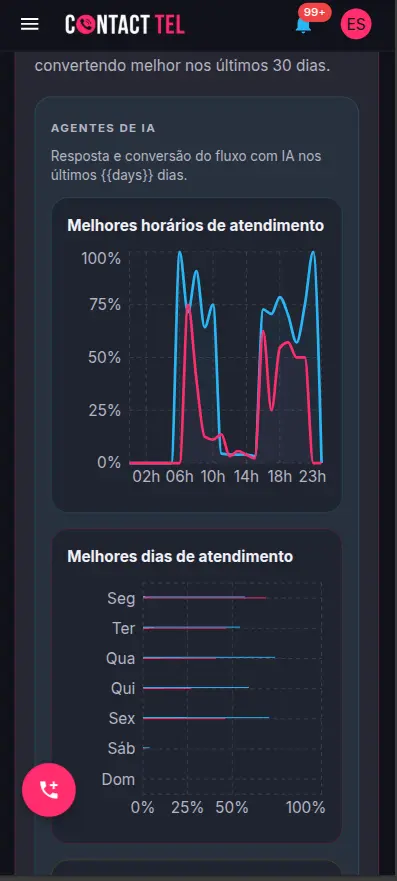
Track contact reasons, routes, transfers and outcomes to keep improving your operation.
Callers explain what they need without relying only on a sequence of keypresses and menus.
The agent considers what has already been said, the approved knowledge and the operation's rules.
Data can be looked up, confirmed and logged in the systems included in the project.
When a person needs to take over, the request and the information collected arrive organized.
From menu to conversation
Keypad menus are still useful when there are only a few clear options. The problem starts when callers have to listen to a long tree, pick an approximate route or repeat information after a transfer.
With conversational AI, customers can explain why they're calling. The agent interprets the request, collects what's missing and decides the next step within the rules your company defines.
AI doesn't eliminate rules. It turns rules, knowledge and integrations into a more direct conversation.
The agent answers on the number and during the hours defined for the operation, with a short, clear greeting.
The AI interprets the request, keeps the context and only asks questions when it needs to complete the information.
The agent answers, collects, looks up, logs or applies the routing defined in your business rules.
The request can be completed by the AI or reach a person along with the relevant conversation history.
What the project can include
The scope is defined according to contact reasons, available systems and the right level of autonomy for each task.
Identify why people are calling and resolve predictable steps without sending every request to a human queue.
Route by intent, context, profile, time of day or any other rule defined with your company.
Answer based on approved content, without inventing information outside the scope.
Integrate CRM, ERP, scheduling, WhatsApp or other systems the flow needs.
Collect and confirm only the data required, with security rules suited to the task.
Transfer exceptions, sensitive situations and opportunities that require a decision or negotiation.
Modernization without disruption
A simple IVR can still handle straightforward routes well. AI comes in where natural language, context, data lookups or task resolution reduce friction. The migration can happen by flow, number or contact reason.
Map my current setupTelephony and capacity
The architecture covers numbers, telephony, minutes, concurrent calls and integrations. Operating hours follow your business rules, including when service needs to run 24/7.
Use the telephony included in the solution or keep a compatible SIP/VoIP carrier you already have.
Size how many conversations can happen at the same time based on your operation's peaks.
Define hours, identification, security, logging and transfer criteria before scaling.
Custom implementation
We analyze your existing setup and the knowledge your people use. The agent is built for that operation's contact reasons, rules, systems and limits.
We identify menus, contact reasons, integrations, hours, transfers and drop-off points.
Not every step needs to change. We keep what works and redesign what needs context or flexibility.
Your company's content, rules, examples and exceptions become testable behavior for the voice channel.
We test scenarios, measure routes and expand service without forcing an abrupt replacement of your entire infrastructure.
Before you modernize
Straight answers about migration, natural language, telephony, human service and investment.
It is a phone customer service solution that combines routing and self-service with speech recognition, context, rules and integrations. With a conversational AI IVR, callers can explain what they need in their own words, without relying only on fixed menus.
A traditional IVR usually walks callers through predefined keypad options or short commands. An AI IVR can interpret sentences, keep context, look up data and carry out tasks within defined limits.
No. Modernization can be gradual. Simple menus and routes that work can stay, while the AI takes on requests that benefit from natural language, context and integration.
Yes. Transfers can happen by intent, rule, time of day, risk or at the caller's request. The goal is to route the call with the context already collected.
Contact Tel can provide the telephony or use a compatible SIP/VoIP setup your company already has. Feasibility and architecture are assessed when designing the project.
Yes. You define the operating days and hours, including round-the-clock service. Capacity is sized by minutes and concurrent calls, not by a time-of-day surcharge.
The implementation defines authorized knowledge, limits, rules, validations, exception routes and tests. Situations outside the scope can be logged or transferred to a person.
Track misrouting, first-contact resolution, number of turns, abandonment, handling time, transfers, satisfaction and task outcome.
Investment depends on minute volume, concurrency, integrations, telephony and implementation complexity. The initial assessment sizes the flow before the proposal.
Show us how your IVR or phone service works today. Contact Pró assesses contact reasons, integrations, telephony, concurrency and human routes to design a safe upgrade.
Talk about my IVRWant to compare capacity and investment? See how custom Contact Tel plans work. Or explore all use cases.